
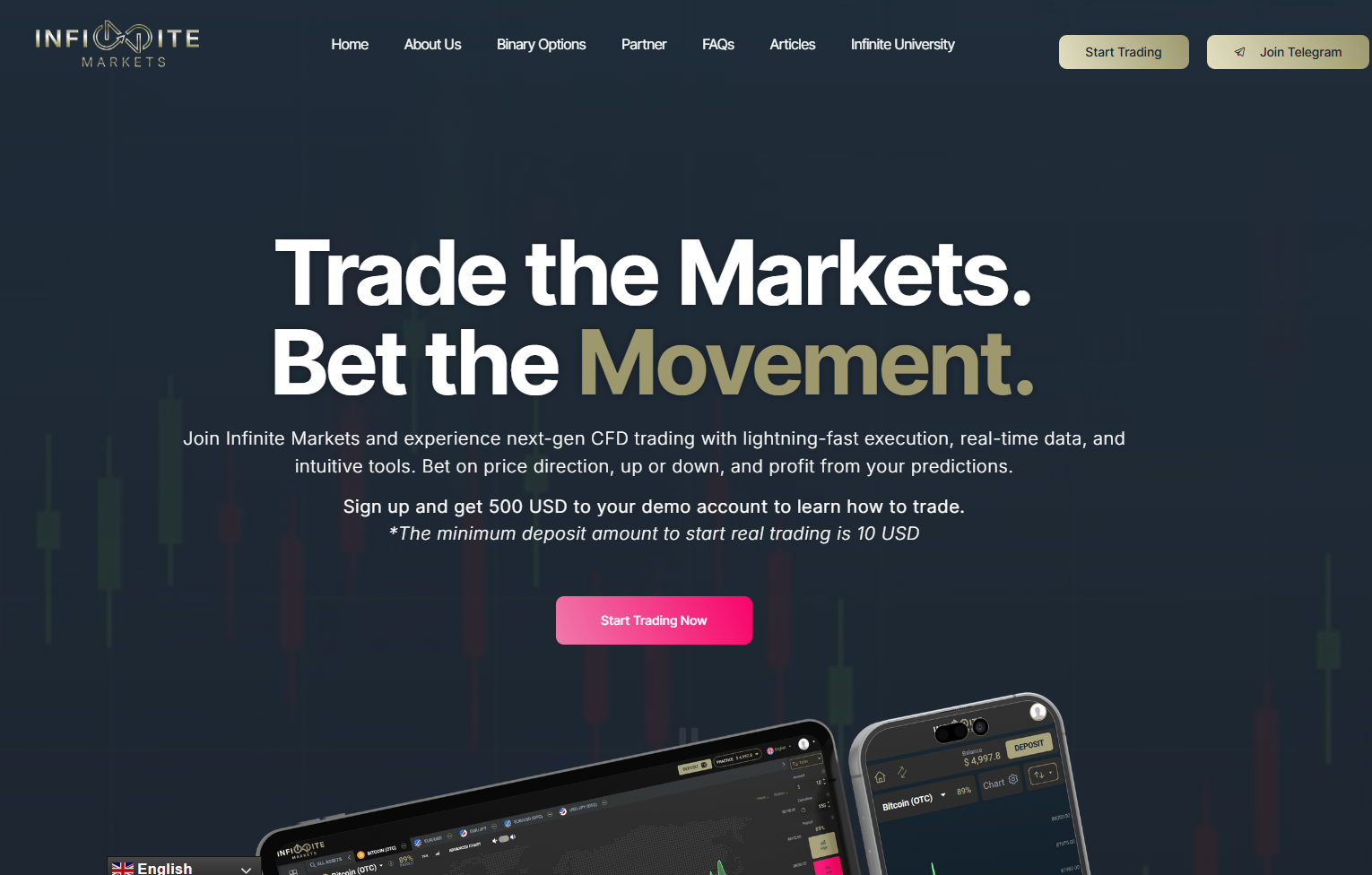

Online trading platforms can make investing seem simple: choose an asset, predict whether its price will rise or fall, and place a trade. InfiniteMarkets.trade presents its services in much the same way. It promotes CFDs and binary options, along with tools it says make trading quick and accessible. The site also advertises a demo account and a low minimum deposit.
However, these are the platform’s own claims—not independent proof of its reliability or regulatory status. Before signing up, prospective users should distinguish what the site says it offers from what they can verify, especially if the platform is unregistered.
What InfiniteMarkets.trade says it offers
Infinite Markets describes itself as an online platform for trading contracts for difference, or CFDs. Users can select an asset, choose whether to trade on a price rise or fall, and open a position. The site advertises CFDs on stocks, indices, commodities, and other markets. It also says the platform uses TradeSmarter technology and TradingView charts. Those names describe the tools the platform says it uses. They don’t, by themselves, show how it executes trades, sets prices, or protects customers. The site also promotes binary options. These trades involve predicting whether an asset’s price will be above or below a particular level after a set period. Infinite Markets advertises a demo account with a stated balance of 500 USD and says users can start trading with a minimum deposit of 10 USD. Its binary-options page also mentions bonuses and integrated trading signals. These features may make the platform seem easy to try. Still, they don’t reduce the risk of losing money.Getting started
The platform’s onboarding guide outlines a short process: create an account, verify your identity, add funds, choose an asset, and place a long or short trade. The site says it offers more than 100 CFDs and also promotes tournaments and partner offerings. Because these details come from the platform, read the terms carefully before relying on them. In particular, check for fees, eligibility rules, and conditions attached to bonuses or other promotions.CFDs and binary options work differently
Although the site uses both “CFD trading” and “betting” language, CFDs and binary options are different products. A CFD is a derivative contract linked to the price of an underlying asset. You don’t necessarily own the share, commodity, or index itself. Depending on the contract, leverage can magnify both gains and losses. You may also face fees for opening a trade or holding a position. Binary options have a different structure. Their outcome usually depends on whether a specific condition is met by a set expiry time—for example, whether an asset’s price sits above or below a chosen level. Infinite Markets describes its binary options as fixed-risk trades with potential returns known in advance. However, “fixed-risk” doesn’t mean low-risk. A losing trade can still cost you the full amount you stake, and repeated losses can quickly add up. The platform itself warns that users could lose their entire investment. Before trading either product, make sure you understand exactly what you’re buying, how the platform settles the trade, and how it calculates prices and outcomes. A simple interface may make a complex product easier to use, but it doesn’t necessarily make the product easier to evaluate.A company registration isn’t a trading licence
Infinite Markets’ website identifies a company called Infinite Markets Ltd. and lists an incorporation number and a Saint Lucia address. Even if those details are accurate, they don’t establish that the company has authorization to provide investment services. Incorporation creates a corporate record. It doesn’t confirm that a financial regulator has reviewed the firm’s trading activities, customer-fund arrangements, or complaint procedures. The available website information doesn’t identify a financial regulator, provide a licence number, or clearly name a regulated entity responsible for the services. That’s an important information gap, although it isn’t proof of fraud or misconduct. Registration requirements vary by product, company location, and customer jurisdiction. For example, different rules may apply to dealing in securities, operating a trading venue, holding client funds, or offering derivatives. So, check regulatory status independently. Don’t rely only on the company’s address, its website statements, its software providers, or familiar charting tools. The U.S. Securities and Exchange Commission, for example, advises users not to assume that a platform calling itself an exchange is registered or operates like a regulated exchange. Its guidance also recommends checking registrations, fees, trading procedures, and safeguards for customer assets. The rules differ by country and product, but the key point remains the same: confirm that the firm holds the authorization it needs to offer the service.Claims that deserve a closer look
Marketing language and demo accounts
Infinite Markets uses promotional terms such as “simple,” “fast,” and “profitable,” while highlighting its low minimum deposit and demo account. These claims are marketing—not evidence that users are likely to earn money. Trading results depend on market movements, product terms, execution, and a user’s decisions. Moreover, a demo account can’t show whether real-money trading will work the same way.Customer and activity figures
Some of the platform’s public claims are hard to assess. One homepage excerpt displayed zero for several headline statistics, while another page claimed more than 584,700 traders. These figures could reflect a display issue or another problem, but they aren’t independently verified measures of customer activity. For that reason, treat them as unconfirmed unless the platform provides clear, auditable evidence.Pricing and execution
The site describes its pricing as “real-time” and its execution as “lightning-fast.” Those phrases leave several practical questions unanswered. Who supplies the quoted prices? Can they differ from prices elsewhere? What happens to orders during volatile markets, outages, or market closures? And how does the platform handle rejected, delayed, or disputed trades? The references to TradeSmarter and TradingView identify technology the site says it uses. They don’t explain how the platform executes orders or whether it routes them to an exchange.Withdrawals and fees
The binary-options FAQ says withdrawals generally take one to five days, depending on processing volume. It also says the broker doesn’t charge withdrawal fees, although payment providers may charge fees or currency-conversion costs. Before depositing, read the full terms. Look for identity-check requirements, minimum withdrawal amounts, bonus restrictions, payment-method rules, and conditions that could delay or prevent a withdrawal.Risk warnings
The site warns that binary options could result in the complete loss of invested capital and advises users to trade only with money they can afford to lose. That warning matters. However, a disclaimer doesn’t verify the company’s regulatory status, demonstrate that it handles trades fairly, or guarantee access to an effective dispute-resolution process.Questions to answer before depositing
Before putting money into an account, get clear answers—in writing—to these questions:- Who is the contracting company? Check the full legal name and address in the customer agreement, not just the brand name.
- Which regulator authorizes it? Ask for the regulator, licence number, and activities the licence covers. Then check the regulator’s own register and confirm that the company and website match.
- Where does the company hold customer funds? Find out who holds the funds, whether the company segregates them, and what protections apply if it fails.
- How does the platform handle prices and trades? Read the execution policy and fee schedule. Check its rules for rejected trades, price disputes, outages, and closing positions.
- What conditions apply to withdrawals? Review verification requirements, payment methods, processing times, fees, and any restrictions tied to bonuses.
- How does the company handle complaints? Find out whether an independent regulator, ombudsman, or dispute-resolution body can review a complaint.
- What personal information does it require? The site says users must verify their profiles. Before submitting documents, understand what it requests and how it uses that information.
What Should You Do If You’ve Been Affected?
If you have interacted with InfiniteMarkets.trade, consider taking the following steps as soon as possible:- Stop sending any further funds
- Keep a record of all transactions and communications
- Carefully review your situation before taking any additional action